 OtterclueHome
For grown-ups · Case preview

The Case of the School Fair Takings
About 25 minutes · on a phone or tablet · no sign-up needed to start
What your child learns
- Completing a table from a line graph: each dot is one value, read up from the gridlines to the dot's height, and the line between two dots only joins them
- Drawing a line graph: one dot for each value, placed at its height, and the line joins the dots in day order (a dot off its height bends the line the wrong way)
- Reading a pie chart: a pie is one whole split into parts, so the slices add up to the whole and the missing slice is what the others leave
What's in the case
Case 1 · Cones on the Dots
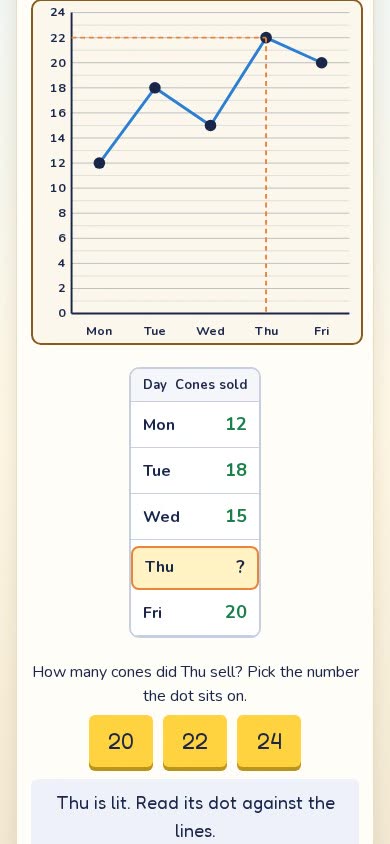
Your child taps a blank day in the table, and its dot lights up on the line graph. They read the dot against the gridlines and pick its number. A wrong number shows whether it sits too high or too low.
Case 2 · Drawing the Line
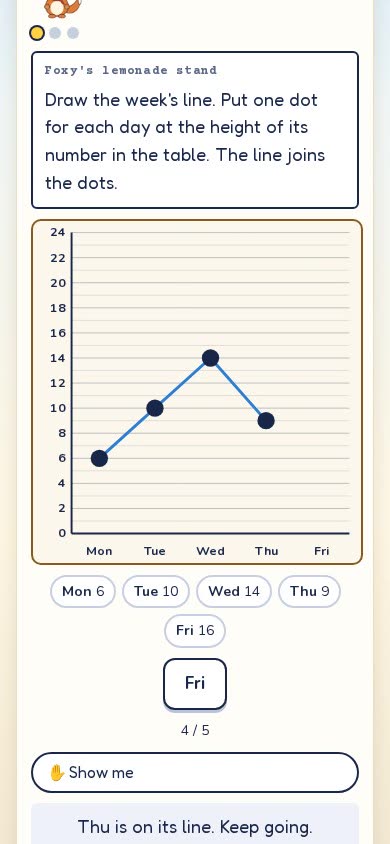
Your child drags a day's dot up to its column, or taps the dot and then the column, at the height of that day's number. A wrong dot stays red with the table's number beside it, and the line joins the dots as they land.
Case 3 · Closing the Pie
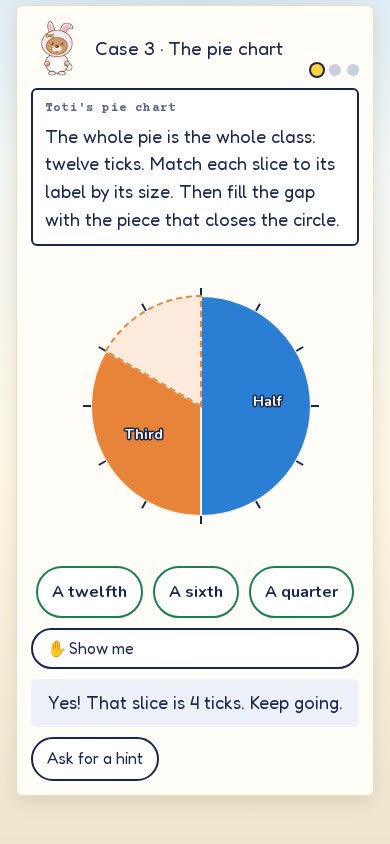
Your child matches each slice to its label by size (a half, a third, a sixth), then fills the gap with the piece that closes the circle. A piece that is too big or too small shows why in the same picture.
The final puzzle
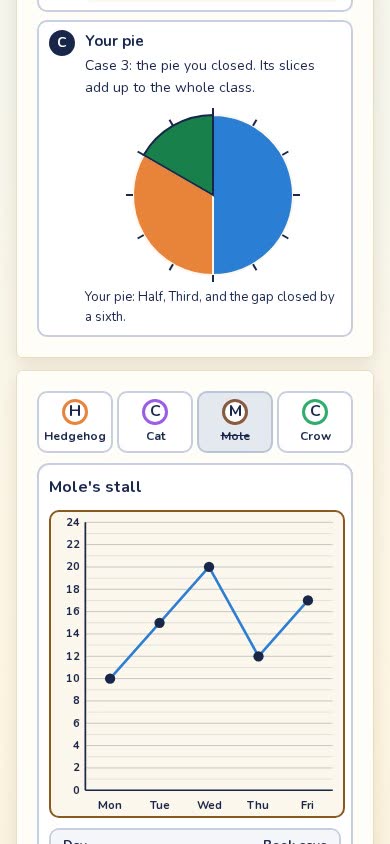
Count Blocko tampered with three fair stalls, one fault for each card: a book number, a missing dot and a short pie. Your child's own table, line and pie are the three cards. Your child checks all four stalls card by card, by tapping the day, the empty dot or the empty part of the pie, and only then picks the stall whose book was changed.
Where it sits in your curriculum
England National Curriculum
- Year 4 · Bar charts and time graphs
Best handed to your child: their progress and medal are saved on their badge.
See every topic on the curriculum tree← Back to all cases