The Case of the Sleepy Clock Tower
The town clock tower has stopped, and its golden key is gone!
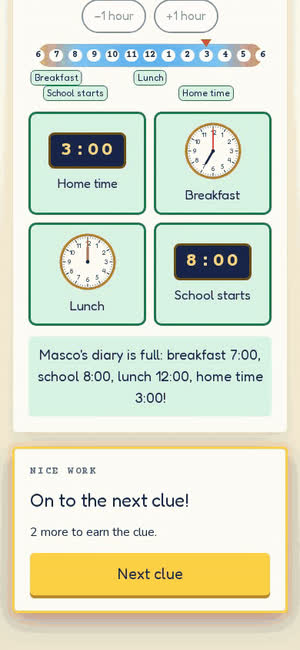
What they learn: O'clock on analogue and digital clocks, times of the day in order
Start with your childSee what they'll learn firstOtterclue
Cases matched to P1-P4 school maths, 20 to 30 minutes each. No sign-up, no ads.
The witness walked past the clock shop at half past 3. Turn the hands to half past 3.
Saved on this device only. Change it any time.
The town clock tower has stopped, and its golden key is gone!
What they learn: O'clock on analogue and digital clocks, times of the day in order
Start with your childSee what they'll learn first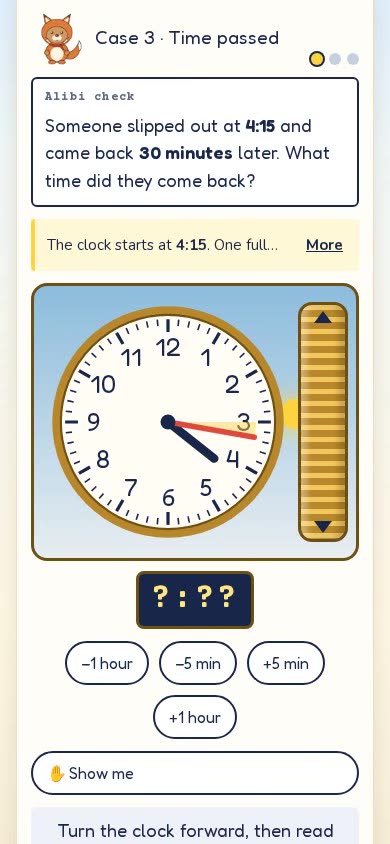
Grandpa's gold pocket watch has vanished from the clock shop safe!
What they learn: Reading clocks, setting the hands, elapsed time
Start with your childSee what they'll learn first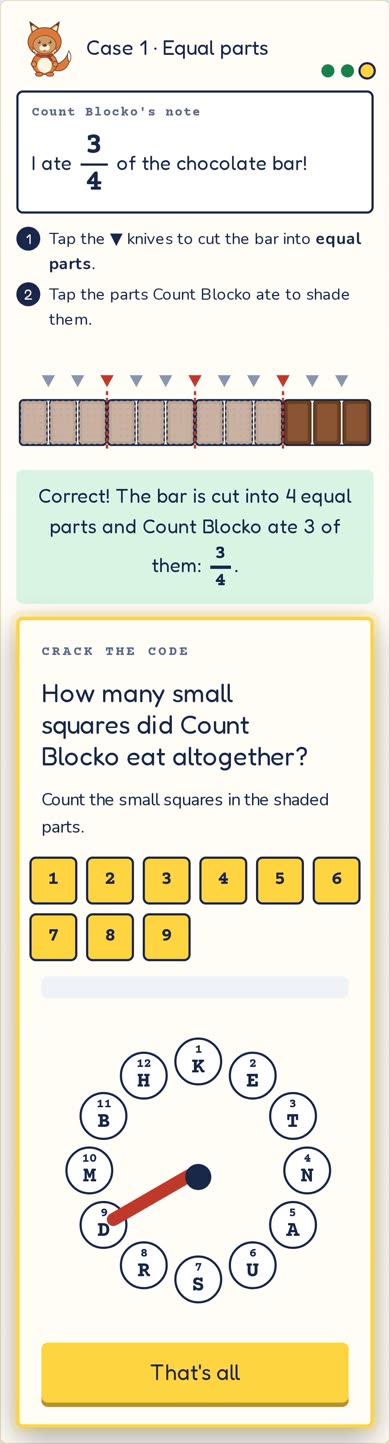
Count Blocko has nibbled the chocolate, pinched the jewels and snipped some words, but always fairly, in equal shares.
What they learn: Equal parts, numerator and denominator, fractions of a set
Start with your childSee what they'll learn first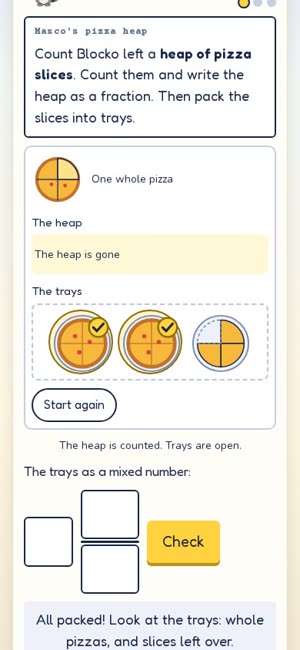
An order slip has vanished from the Otter Bakery!
What they learn: Mixed numbers and improper fractions: packing slices into trays (11/4 counts slices, 2 3/4 counts pizzas and the slices left), cutting whole bars into pieces (3 2/5 is 17/5), and an improper fraction and its mixed number sitting on the same spot of a number line
Start with your childSee what they'll learn firstNo sign-up needed. 20 to 30 minutes each, on a phone or tablet.
Seeing cube towers from the front and side, counting blocks
Spatial thinking beyond the school syllabus
PlayWhat will my child learn?Equal parts, numerator and denominator, fractions of a set
PlayWhat will my child learn?Reading clocks, setting the hands, elapsed time
PlayWhat will my child learn?Sharing equally, grouping, remainders
PlayWhat will my child learn?Word problems: add or take away, carrying with base-ten blocks, tally charts and bar graphs
PlayWhat will my child learn?O'clock on analogue and digital clocks, times of the day in order
PlayWhat will my child learn?Undoing addition, number line hops, trading tens, word problems
PlayWhat will my child learn?Equal groups, arrays and turning them, skip counting in 2s, 3s, 4s, 5s and 10s, sharing back with division
PlayWhat will my child learn?Counting coins in cents up to $1, the same money with fewer coins, counting notes in dollars up to $100, tens first
PlayWhat will my child learn?Counting coins and notes, writing $3.05, paying exact amounts, giving change
PlayWhat will my child learn?Naming flat shapes even when turned or stretched, building pictures from shapes, finishing patterns, solids that roll and stack
PlayWhat will my child learn?Fewer than and more than, two-step problems, rulers that don't start at 0, counting up across zeros
PlayWhat will my child learn?Measuring in cm with a ruler, drawing a line to a length, choosing cm or m, g or kg, ml or ℓ, a balance scale, a measuring jug
PlayWhat will my child learn?Adding and subtracting fractions within one whole: pieces of one size just count, cutting halves into eighths (or fifths into tenths) so they match, taking a bite off a cake
PlayWhat will my child learn?How far an angle turns, right angles with a folded paper corner, smaller and bigger than a right angle, parallel and perpendicular lines on a dot grid
PlayWhat will my child learn?Hundreds, tens and ones, ten ones make a ten, comparing and ordering, counting in tens and hundreds, reading number words
PlayWhat will my child learn?Compound units (1 m 5 cm, 2 kg 50 g, 1 ℓ 250 ml), converting between compound and single units, comparing and adding measures
PlayWhat will my child learn?Lining a pile up in rows to see the most and fewest, how many more and how many altogether, picture graphs where one picture stands for 2, 5 or 10
PlayWhat will my child learn?Covering a plot with square tiles, area in cm² and m², the way all around a fence, missing sides, rows times columns, one area with different fences
PlayWhat will my child learn?Ten hundreds make a thousand, four-digit place value, writing numbers from words with their zeros, jumping in thousands, hundreds and tens, comparing four-digit numbers place by place
PlayWhat will my child learn?Column addition with carrying and column subtraction with borrowing up to 4 digits, borrowing across zeros, quick mental paths for two 2-digit numbers, checking an addition by subtracting back
PlayWhat will my child learn?Long multiplication of 4 digits by 1 digit and 3 digits by 2 digits (cut-up rectangles, carries, the placeholder zero) and long division of 4 digits by 1 digit (sharing blocks biggest first, breaking leftovers, remainders)
PlayWhat will my child learn?Factors as row sizes that leave nothing over, factor pairs from rectangles, whether a frog's hops land exactly (factor of, multiple of, remainder), common multiples of two numbers, common factors of two numbers
PlayWhat will my child learn?Ten thousands and five-digit place value, reading and writing numbers in words, rounding to the nearest 10, 100 or 1000 on a rounding hill, number patterns across 10 000 and 50 000, comparing and ordering five-digit numbers from the biggest place
PlayWhat will my child learn?Tenths, hundredths and thousandths on a zoom line, comparing and ordering decimals (0.7 is 0.700), 0.25 as 25/100 on a hundred grid, 3/5 as 6/10 as 0.6, rounding to a whole number, 1 and 2 decimal places
PlayWhat will my child learn?Mixed numbers and improper fractions: packing slices into trays (11/4 counts slices, 2 3/4 counts pizzas and the slices left), cutting whole bars into pieces (3 2/5 is 17/5), and an improper fraction and its mixed number sitting on the same spot of a number line
PlayWhat will my child learn?Finding a missing side from the area (stretching a garden in rows) or from the fence (half the fence is a length plus a width), the side of a square from its area or its fence, cutting an L-shaped room into rectangles for its area, sliding the steps out for its fence
PlayWhat will my child learn?Identifying symmetric figures, a mirror on a square grid (the half flipped across the line), which straight line (up and down, side to side or slanted) is a line of symmetry, completing a picture square by square about a given line
PlayWhat will my child learn?Adding and subtracting fractions with different bottom numbers (up to twelfths): cutting thirds and quarters until the pieces match, putting pieces on a plate to add or take away, comparing halves with sixths, and checking recipe cards with the clues
PlayWhat will my child learn?Adding and subtracting decimals with two decimal places: putting the digits of two prices in the columns of their places (2.35 + 1.7 is 2.35 + 1.70), borrowing across the empty columns where a borrowed ten becomes ten tenths, paying and giving change with coins where $2.8 is $2.80, and checking a total by taking a part away
PlayWhat will my child learn?Multiplying and dividing decimals by a 1-digit whole number: pouring 0.35 L four times on a place-value chart where ten hundredths trade into one tenth (1.4), sharing 8.40 between four plates where a leftover hands on as ten of the next place (5 divided by 2 is 2.5), rounding the exact answer by the one digit after the place kept (0.694 to 0.69, 2.375 to 2.38), and checking five recipe cards for the one that dropped a carry
PlayWhat will my child learn?Naming angles with notation such as ∠ABC and ∠a (the middle letter is the vertex), measuring an angle in degrees with a protractor (centre on the vertex, 0 line on one arm, read the other arm), and drawing an angle of a given size by turning an arm until it lands on the asked mark
PlayWhat will my child learn?Folding nets into 3D solids: flaps fold up one at a time and the box closes only when every face lands on its own side (a cube net needs six squares, a row of four wraps round the box), matching a net to its cuboid, triangular prism or square pyramid by the faces that meet, and testing which nets of a cube close
PlayWhat will my child learn?Drawing rectangles and squares with a ruler and a set square on a dot grid: a rectangle built to a length and width (its opposite sides are the same length, so two sides are enough), a square drawn with a given side and every side measured (four equal sides), and testing shapes to say which are squares (equal sides with a slanted corner is a rhombus, not a square)
PlayWhat will my child learn?Reading and completing a table from a line graph (each dot is one value, read up from the lines), drawing a line graph one dot for each value (the line only joins them), and reading a pie chart whose slices add up to the whole (match each slice to its size, then find the missing slice)
PlayWhat will my child learn?Sliding a shape across a grid without turning, predicting mirror flips (left-right and top-bottom), clockwise turns (90°, 180°, 270°), and telling a flip from a pure turn
PlayWhat will my child learn?Naming 3D solids (cube, cuboid, sphere, cylinder, cone, tetrahedron, square-based pyramid, triangular prism), counting flat faces, edges, and vertices by tapping on the 3D shape, and matching 3D property clues
PlayWhat will my child learn?Every topic in the curriculum. The ones with an apple have a case to play now; the rest are growing.
An email when new cases are added. Nothing else.