 OtterclueHome
For grown-ups · Case preview
The Case of the Borrowed Corners
About 25 minutes · on a phone or tablet · no sign-up needed to start
What your child learns
- An angle is how far something turns, not how long its arms are: a short-armed angle can be bigger than a long-armed one
- Using a folded paper corner to find right angles, and angles smaller or bigger than a right angle, in a house, a slide and a tent
- Spotting parallel lines (always the same distance apart) and drawing parallel and perpendicular lines on a dot grid
What's in the case
Case 1 · Masco's Hinge
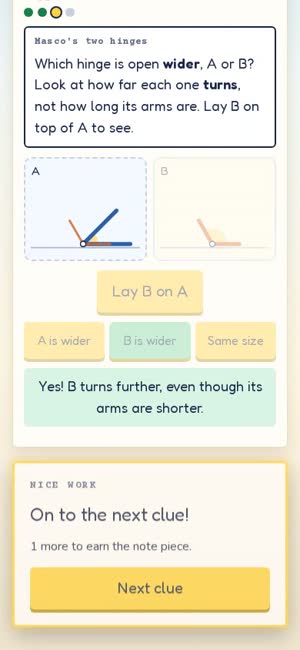
Your child opens a door and a pair of scissors by dragging a hinge, first to less than a right angle, then to exactly a right angle. Then two hinges are laid on top of each other to see which one turns further, even when its arms are shorter. A wrong try shades the part that is too much or too little.
Case 2 · Foxy's Corner Checker
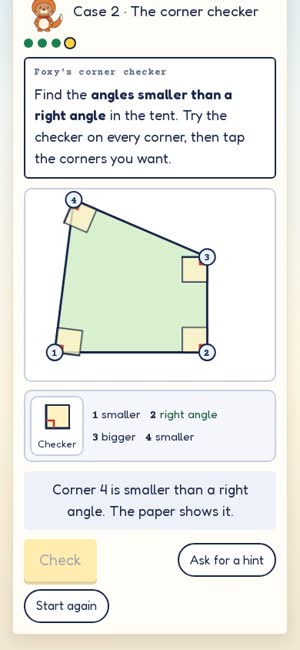
Your child folds a sheet of paper twice into a corner checker, then drags it onto the corners of a house, a slide and a tent to find the right angles, the bigger ones and the smaller ones. A wrong tap shows the paper laid on that corner.
Case 3 · Toti's Rails
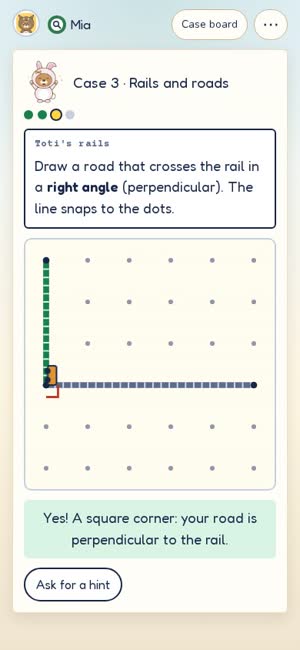
Your child spots which lines are parallel to a rail by looking at ties of equal length, then draws a parallel rail, a road that crosses in a right angle, and a rail with a road across both. Lines snap to the dots, and every drag can be done by tapping two dots instead.
The final puzzle
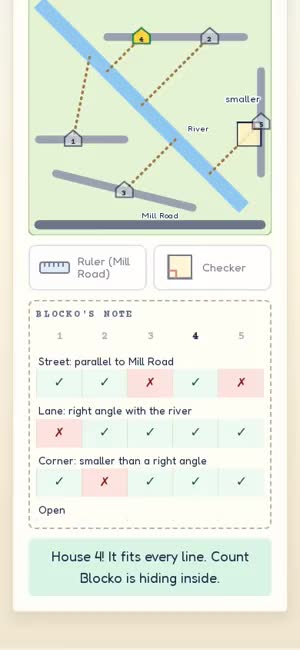
Count Blocko hides in one of five houses on his map. His torn note has three lines: a street parallel to Mill Road, a lane in a right angle with the river, and a corner smaller than a right angle. Your child tests each house with a ruler and the corner checker, fills in the note, and opens the one house that fits all three.
Where it sits in your curriculum
Singapore MOE syllabus
- P3 · Angles, Perpendicular and Parallel Lines
Best handed to your child: their progress and medal are saved on their badge.
See every topic on the curriculum tree← Back to all cases