 OtterclueHome
For grown-ups · Case preview

The Case of the Mixed-Up Price Tags
About 25 minutes · on a phone or tablet · no sign-up needed to start
What your child learns
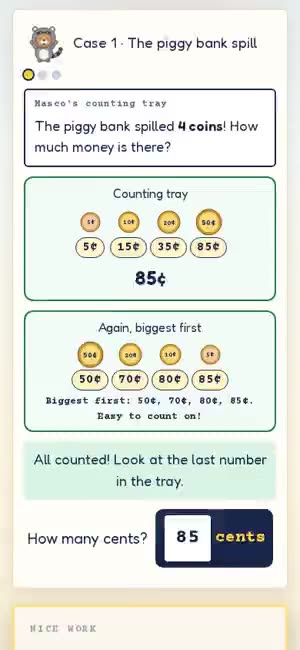
- Counting coins in cents up to $1: counting the biggest coin first makes it easy to count on (50, 70, 80, 85)
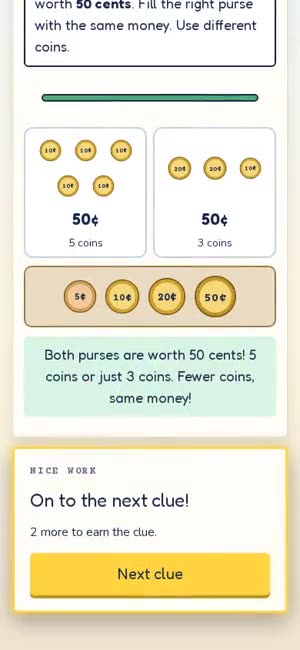
- The same money can be made with different coins, and fewer coins can be worth the same
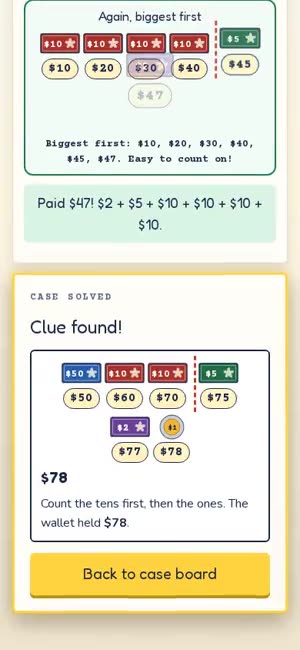
- Counting notes in dollars up to $100: the tens first, then the ones, makes it easy
What's in the case
Case 1 · Masco's Counting Tray
A piggy bank spills 85 cents, 95 cents and then $1. Your child slides the coins into a counting tray in any order and the tray counts on with a rising tone; it then replays the coins biggest first, and your child writes the total.
Case 2 · Foxy's Money Scale
Two purses sit on a money scale. Your child fills them with the same amount in different coins (50 cents as five 10 cent coins, or as one 50 cent coin) and sees that fewer coins can be worth the same.
Case 3 · Toti's Wallet
Notes in a wallet: your child counts $27 and $78, and pays a $47 price from the wallet with any notes that make it.
The final puzzle
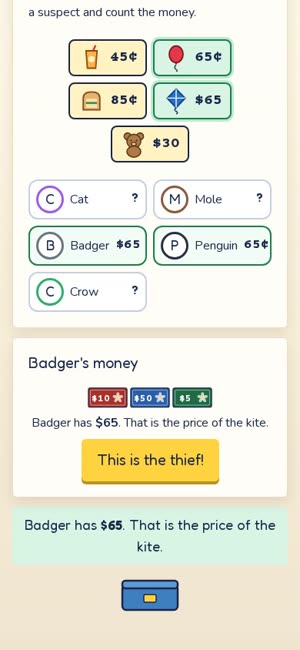
At a fun-fair stall the price tags are mixed up. Your child counts each suspect's purse or wallet, sees which price tag it matches, and finds the thief whose money is exactly the price of the kite (65 cents is not $65).
Where it sits in your curriculum
England National Curriculum
- Year 1 · Length, mass, capacity and money
Best handed to your child: their progress and medal are saved on their badge.
See every topic on the curriculum tree← Back to all cases